 En
En  Ar
Ar 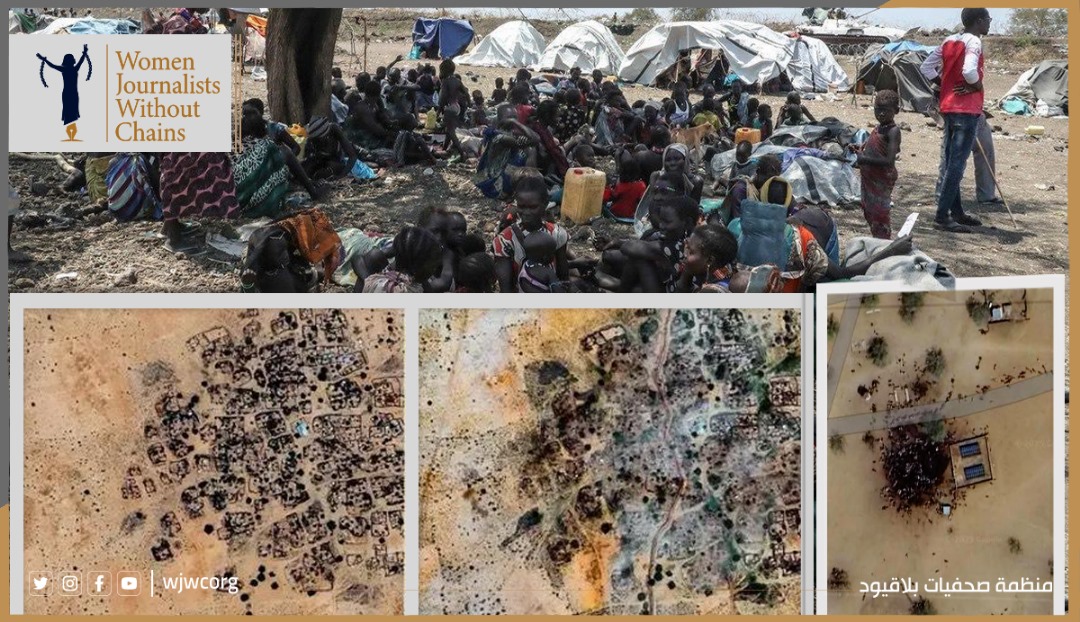
Women Journalists Without Chains (WJWC) warns that the continued failure of the international community to take meaningful action to halt the crimes committed by the Rapid Support Forces (RSF) in Sudan—particularly in Kordofan and Darfur—now amounts to complicity through inaction.
This failure persists despite mounting evidence presented by the United Nations and independent investigators confirming that violations taking place on the ground constitute grave breaches of international humanitarian law, the Geneva Conventions, and the Rome Statute of the International Criminal Court. Although UN warnings have reached the highest diplomatic levels, international response remains limited to statements of concern, reflecting a disturbing disregard for the scale and systematic nature of atrocities committed against civilians.
WJWC notes that its field teams and monitoring networks inside Sudan have documented patterns of violence that fully align with recent UN briefings, including statements by the UN High Commissioner for Human Rights, Volker Türk. In his latest warning, Türk spoke of a “new wave of atrocities” as fighting intensified across the Kordofan states. According to his office, since 25 October at least 269 civilians have been killed through airstrikes, shelling, and summary executions.
Available evidence strongly suggests that the actual death toll is significantly higher due to prolonged communications blackouts. WJWC has documented credible reports of retaliatory killings, arbitrary arrests, sexual violence, and forced recruitment, including of children. These crimes have occurred alongside the prolonged siege of Kadugli, Dilling, and El Obeid, confirmed famine conditions in Kadugli, and imminent famine risks in Dilling. The High Commissioner further confirmed that RSF forces continue to obstruct humanitarian aid, in direct violation of Article 23 of the Fourth Geneva Convention, which prohibits the starvation of civilians and the denial of relief supplies.
These findings are reinforced by testimony provided by Nathaniel Raymond, Executive Director of Yale University’s Humanitarian Research Lab, during a recent seminar at Harvard University. Raymond disclosed that his research network in El Fasher documented more than 1,200 civilian deaths within hours of the city’s fall, with the number rising to an estimated 10,000 within days before communications were cut—strongly suggesting thousands of additional unrecorded deaths. Using high-resolution satellite imagery, his team identified mass body sites and traced coordinated “kill lines” across the city. He further confirmed that RSF forces carried out organized, systematic killings of the Masalit population in El Geneina, targeting civilians house by house.
El Fasher, Raymond noted, endured an 18-month siege—longer than the siege of Stalingrad—and remained under famine classification for fifteen consecutive months, an unprecedented indicator in modern conflict monitoring.
WJWC stresses that UN reports, independent forensic research, survivor testimonies, and humanitarian documentation converge on a clear conclusion: RSF forces are carrying out widespread and systematic attacks against civilians. These include deliberate killings, starvation as a method of warfare, prolonged sieges, sexual violence, ethnic targeting, destruction of civilian infrastructure, and the obstruction of humanitarian assistance. Taken together, these acts constitute war crimes and crimes against humanity as defined under international humanitarian law and meet the legal thresholds set out in Article 7 of the Rome Statute.
At the same time, credible evidence continues to emerge regarding the supply of weapons to the RSF by the United Arab Emirates, as cited in multiple international reports, including documentation by Amnesty International concerning atrocities in Zamzam displacement camp. Continued arms transfers in the face of well-documented violations represent a breach of international responsibility and may amount to aiding and abetting war crimes under international law.
WJWC affirms that its human rights teams are continuing to monitor developments, conduct direct interviews with survivors, and collect corroborated testimonies documenting summary executions, sexual violence, and ethnically motivated killings. The organization emphasizes that the international community now faces an undeniable reality: time is running out. Allowing civilians to be killed, starved, and besieged without protection renders silence a form of participation in the crime.
WJWC urgently calls for:
- An immediate end to all RSF attacks against civilians.
- The imposition of a comprehensive international arms embargo on the RSF and all entities supplying it, foremost among them the UAE.
- The establishment of an independent international investigation under the mandate of the UN Human Rights Council.
- The activation of international accountability mechanisms against RSF leaders and all individuals or states financing or facilitating their crimes.
- The creation of secure humanitarian corridors and an immediate end to the siege and starvation of affected cities.
WJWC concludes that what is unfolding in Kordofan and Darfur is no longer a matter of military escalation, but an ongoing international crime committed in full view of the world. History will not record this silence as neutrality, but as a failure demanding condemnation and accountability.