 En
En  Ar
Ar Tawakkol Karman Holds Press Conference at UN, Warns Yemen Is Sliding Toward Full-Scale War
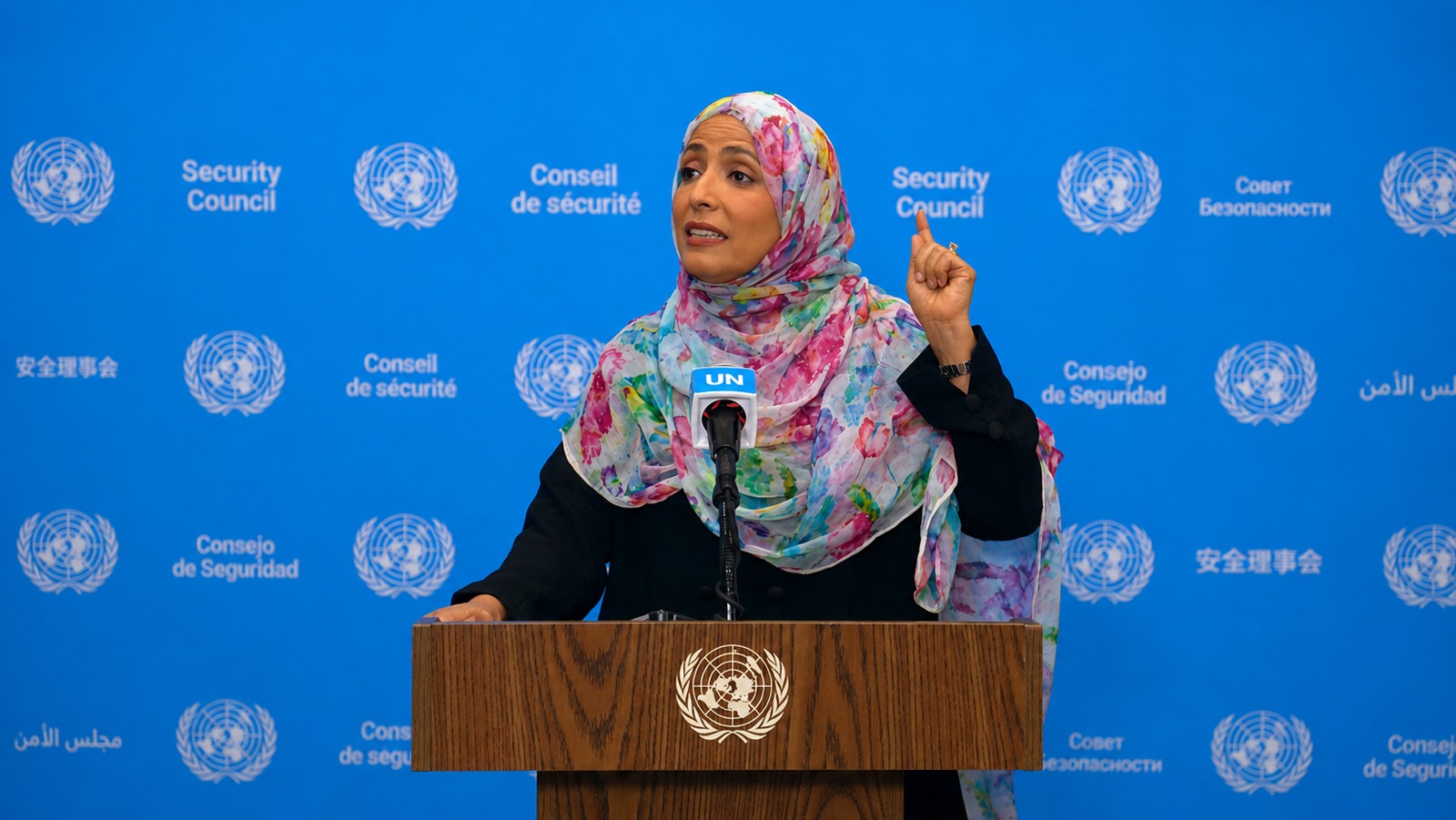
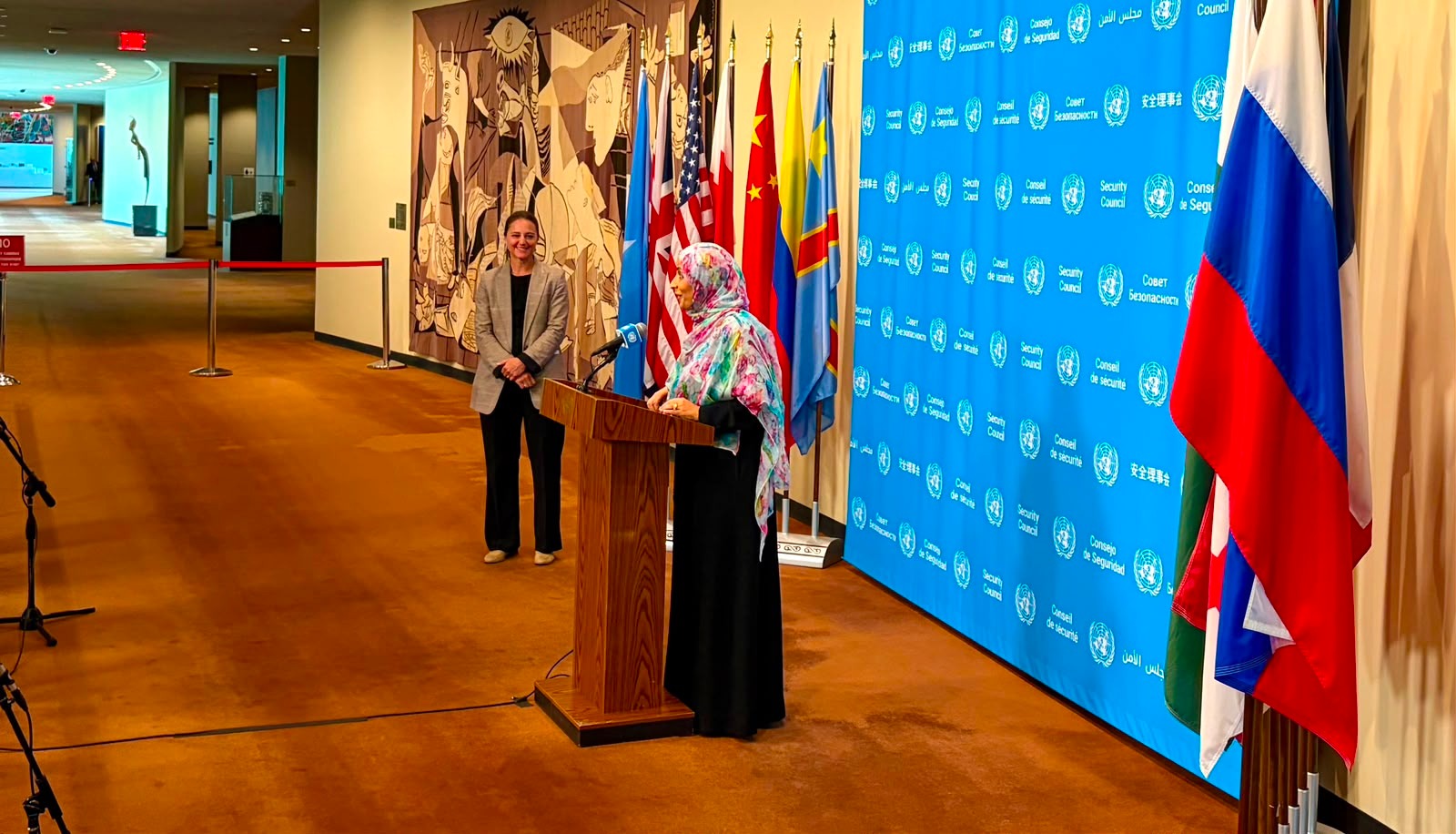
NEW YORK — 13 August 2026 — Nobel Peace Prize laureate and human rights activist Tawakkol Karman held a press conference today, Thursday, 13 August 2026, at United Nations Headquarters in New York, on the sidelines of the UN Security Council session on Yemen.
She warned that recent developments are raising the risk of the country sliding once again into full-scale war.
Karman placed primary responsibility for the collapse of the Yemeni state on the Houthi militia following its seizure of Sanaa in 2014. She said Iran’s military, financial, and logistical support for the militia has prolonged the conflict, undermined prospects for peace, and posed a growing threat to the security of international maritime navigation. She also criticized the poor performance of Yemen’s internationally recognized government, arguing that interventions by the Saudi- and UAE-led coalition have weakened the government, deepened political and territorial fragmentation, and contributed to the proliferation of non-state armed groups.
Karman called on the Security Council to support a Yemeni-led political process aimed at rebuilding state institutions, unifying the country’s military and security institutions, and disarming armed groups. She also called for investigations into crimes committed by all parties to the conflict and urged consideration of establishing a dedicated international judicial mechanism for Yemen.
She stressed that Yemen’s stability, unity, and sovereignty are now directly linked to the security of international maritime navigation, global trade, energy supplies, and international supply chains.
Karman further called for the immediate release of all arbitrarily detained and abducted persons, independent investigations into violations committed by all parties to the conflict, and consideration of a dedicated international judicial mechanism for Yemen. She also urged an end to the provision of weapons, funding, and training to the Houthi militia and other armed groups.
Full statement:
President, Excellencies,
My name is Tawakkol Karman. I am a Yemeni human rights defender and Nobel Peace Prize laureate. I have devoted my life to defending human rights and resisting authoritarianism.
Despite crises across the Middle East commanding the world’s attention, the tragedy of Yemen has receded to the margins of international concern. Yet, millions of civilians continue to pay the price of a war they did not choose, a state stripped of its institutions, and a peace that has been delayed for far too long.
Today, I bring you their voices: Yemenis struggling to survive; women carrying the burdens of war; and children for whom the sound of gunfire has become more familiar than the school bell.
Yemen continues to face one of the world’s largest humanitarian crises. More than twenty-two million people, including almost 11 million women and girls, require humanitarian assistance.[1] More than eighteen million, including over 2 million children under age five, face acute food insecurity.[2] Over 5 million people are internally displaced.[3] Over 4 million children are out of school.[4] Most of the population lives below the poverty line[5] amid the collapse of the economy,[6] depreciation of the national currency,[7] and disruptions to essential services, most importantly, education and healthcare.[8]
Women and girls bear the heaviest burdens of war. 6.2 million women and girls need protection from gender-based violence,[9] while 5.5 million require reproductive health services.[10] Yemen has the highest maternal mortality rate in the region.[11] Over 30% of girls are married before age 18.[12] Many women have become the primary breadwinners, amidst critical conditions.[13]
This suffering is compounded by ongoing human rights violations while the war economy deepens poverty and hunger, expands arms-smuggling networks, and strengthens organized crime and extremism.
President, excellencies,
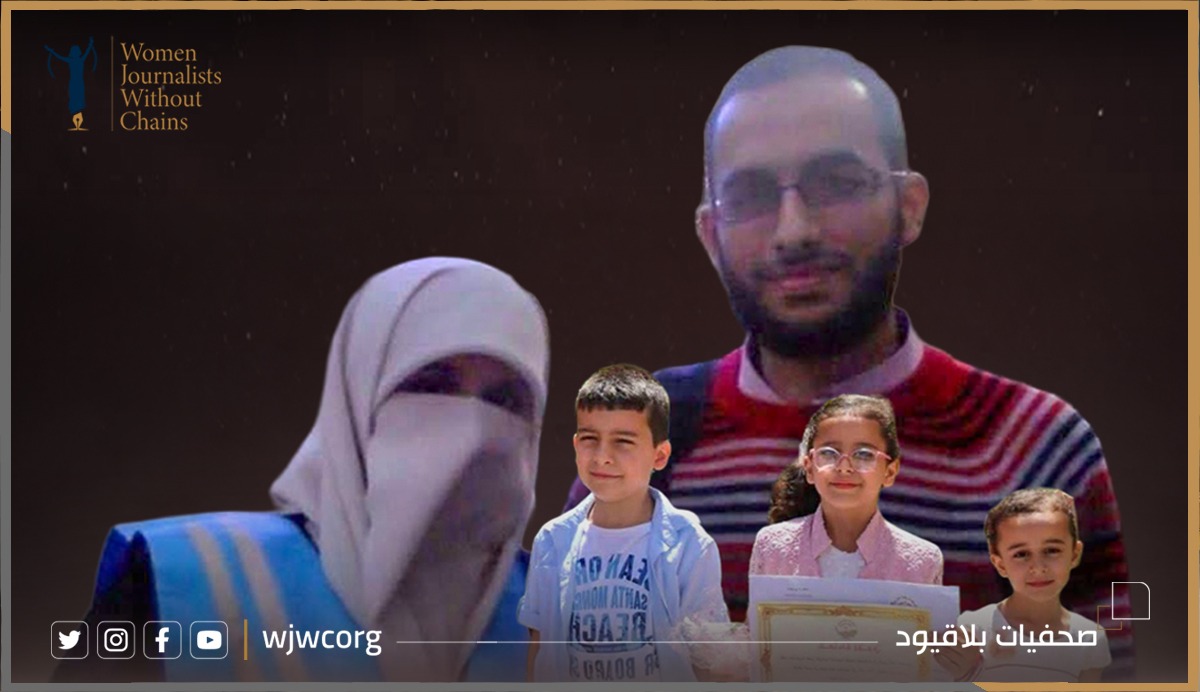
The root cause of Yemen’s humanitarian and human rights crisis is the collapse of the state. The Houthis bear primary responsibility for this collapse since they overthrew the transitional process and seized the capital, Sana’a, in 2014. They have since dismantled state institutions and imposed their authority through violence and the use of arms. They have violated women’s rights and restricted their ability to participate in public life.[14] They have arbitrarily detained and disappeared civilians,[15] including civil society,[16] women activists,[17] journalists,[18] UN staff and politicians.[19] They have also subjected children to systematic ideological indoctrination to foster a culture of violence and hatred, and recruited them to fight.[20] They have laid millions of landmines,[21] and exploited humanitarian suffering as an instrument of war and political coercion.
Iran’s continued military, financial and logistical support to the Houthis has prolonged the war, undermined prospects for peace, and threatened regional security and freedom of international navigation.[22]
At the same time, the internationally recognized government has fallen short of its responsibilities. Poor performance, lack of governance, internal divisions, and the management of the country’s affairs from outside Yemen, rather than from the interim capital, Aden, have contributed to weakening state institutions, undermining the rule of law, and eroding public trust in them.
Further, the intervention of the Saudi-led Arab Coalition,[23] as well as the UAE’s interventions in Yemen,[24] have undermined the internationally recognized government. It has also led to the proliferation of non-state armed groups, human rights violations, deepened fragmentation and threats to Yemen’s unity and sovereignty.
To make matters worse, the international community has failed to fulfill its responsibility to implement Security Council resolutions, protect civilians and ensure accountability for perpetrators of crimes.
The recent developments in Yemen threaten to plunge the country back into a full-scale war. After years of a fragile truce that failed to address the root causes of the conflict, renewed clashes and Houthi missile attacks on Yemen and Saudi Arabia, as well as on shipping in the Red Sea and Bab al-Mandab,[25] have demonstrated that the collapse of an effective Yemeni state is no longer a threat only to its own people: it also endangers international maritime security, global trade, and energy and supply chains security, and undermines regional and international peace and security.[26]
Excellencies,
Throughout Yemen’s peaceful revolution, the transitional period, and the years of war, women have demonstrated that they are not merely victims of war, but indispensable actors in defending human rights, building peace, strengthening democratic institutions and rebuilding the country.
Nevertheless, women remain largely excluded from peace negotiations and decision-making, in clear violation of Resolution 1325 and the outcomes of Yemen’s National Dialogue Conference, which called for women’s participation at no less than 30 per cent.[27] Subsequent peace negotiations did not meet the 30 per cent threshold, and women’s representation in governing institutions has remained extremely limited.[28] The recent appointment of three women to ministerial positions—the first such appointments in six years[29]—is a welcome step. However, it will remain insufficient unless it leads to the active and meaningful participation of women in all stages of peacebuilding and decision-making. No political process can be inclusive or sustainable while continuing to marginalize half of society.
President, Excellencies,
The Yemeni people are not asking the international community to make peace on their behalf. They are asking you to stand with them in their efforts to restore their state and build a united, democratic and sovereign Yemen.
Since Yemen’s peaceful revolution in 2011, the Security Council has been a key partner in supporting Yemen’s transitional process.[30] The UN-supported National Dialogue Conference produced a historic national consensus[31] and its outcomes remain the most realistic foundation for rebuilding the country.
Building on that legacy, and in order to build sustainable peace in Yemen, I urge the Security Council to take the following steps:
First: Press for an end to the war and all attacks on civilians and civilian infrastructure. Further, I urge you to support an inclusive, Yemeni-led political process that restores Yemen’s sovereignty and independent national decision-making; and rebuilds state institutions on the basis of equality, democracy, and rule of law. This will require unifying its military institutions, reforming the security sector and disarming armed groups; and advancing transitional justice, including redress and reparations for victims. Any political process must ensure women's active and meaningful participation—with no less than 30 percent representation—in peace negotiations and all decision-making bodies.
Second: Continue to demand the immediate and unconditional release of all persons arbitrarily detained or abducted, including civil society, women activists, journalists, UN staff, and politicians, and for families to be informed of the fate and whereabouts of their loved ones. Protection and reintegration support should also be provided to those released and to their families. Ensure the removal of restrictions on humanitarian access,[32] the reopening of roads,[33] the lifting of blockades,[34] and the safe, unimpeded and non-politicized delivery of humanitarian assistance, in full compliance with international law.
Third: Support all efforts to conduct independent and impartial investigations of all crimes committed by all parties[35] during the conflict, including violations of women’s rights,[36] targeting of politically active women,[37] and all forms of sexual and gender-based violence,[38] and to ensure accountability of perpetrators, and justice for the victims. The Council should also consider establishing a special international judicial mechanism for Yemen to prosecute war crimes and crimes against humanity.
Fourth: Press all parties to protect and reunify national economic institutions; ensure the regular payment of public-sector salaries;[39] dismantle the war economy; prevent the use of humanitarian assistance, airports, ports, and economic infrastructure as instruments of political coercion or collective punishment;[40] support recovery and reconstruction efforts, and combat corruption, with effective oversight and transparency.
Fifth: Press all external actors to end the provision of weapons, funding, training and military support to the Houthis and other armed groups. Further, the Council must enforce its sanctions regime and hold accountable all those who fuel human rights violations, undermine peace or threaten Yemen’s sovereignty, unity or territorial integrity.[41]
President, Excellencies,
Fifteen years ago, I was deeply honored to receive the Nobel Peace Prize for standing with my country and its brave people in their peaceful struggle for freedom, dignity, democracy and human rights. I invite you to stand with them — not only because they deserve peace, but because a sovereign, democratic and stable Yemen is essential to regional and international peace and security. The Yemeni people are ready to be your partners in building that future.
Thank you.
[1] 2026 Yemen Humanitarian Needs and Response Plan, p. 4, March 2026, https://yemen.un.org/en/312711-ocha-yemen-yemen-humanitarian-needs-and-response-plan-2026-march-2026.
[2] Briefing to the Security Council on the humanitarian situation in Yemen by Tom Fletcher, Under-Secretary-General for Humanitarian Affairs and Emergency Relief Coordinator, 16 June 2026, https://www.unocha.org/news/un-relief-chief-tells-security-council-yemen-must-not-be-forgotten-hunger-deepens; OCHA, “Yemen Humanitarian Update - April 2026,” 14 May 2026, https://www.unocha.org/publications/report/yemen/yemen-humanitarian-update-april-2026-enar.
[3] 2026 Yemen Humanitarian Needs and Response Plan, p. 4, March 2026, https://yemen.un.org/en/312711-ocha-yemen-yemen-humanitarian-needs-and-response-plan-2026-march-2026.
[4] UNICEF, “Yemen Humanitarian Situation Report No. 2 (End of Year), 31 December 2025,” p. 2, 7 April 2026, https://www.unicef.org/media/179861/file/Yemen-Humanitarian-Situation-Report-No.2(End%20of%20Year),31-December-2025.pdf.pdf.
[5] Approximately three-quarters of the population live below the poverty line. World Bank Group, “Yemen Economic Monitor: Pushing Against the Tide,” p. 2, 19 May 2026, https://documents.worldbank.org/en/publication/documents-reports/documentdetail/099630405192627146.
[6] Saeed al-Batati, “Ten years on, Yemen’s economic war is raging more than ever,” The New Humanitarian, 5 March 2025, https://www.thenewhumanitarian.org/news-feature/2025/03/05/ten-years-yemen-economic-war-raging-more-ever.
[7] Final Report of the Panel of Experts on Yemen, ¶24-26, 17 October 2025, S/2025/650, https://docs.un.org/en/S/2025/650; Mohammed Ali Thamer, “Poverty in Yemen: Tracing the Path to Economic Downturn,” Carnegie Endowment for International Peace, 12 September 2024, https://carnegieendowment.org/sada/2024/09/poverty-in-yemen-tracing-the-path-to-economic-downturn.
[8] OCHA, “Yemen Humanitarian Update - April 2026,” 14 May 2026, https://www.unocha.org/publications/report/yemen/yemen-humanitarian-update-april-2026-enar; 2026 Yemen Humanitarian Needs and Response Plan, pp. 7-9, 44-45, March 2026, https://yemen.un.org/en/312711-ocha-yemen-yemen-humanitarian-needs-and-response-plan-2026-march-2026; Al Jazeera, “Yemen’s crumbling health system leaves patients without treatment options,” 6 February 2026, https://www.aljazeera.com/features/2026/2/6/yemens-crumbling-health-system-leaves-patients-without-treatment-options; Alexander Kochenburger, “Recovering from Attacks on Education in Yemen,” Sana’a Center for Strategic Studies, 27 February 2025, https://sanaacenter.org/publications/policy-research/24267.
[9] 2026 Yemen Humanitarian Needs and Response Plan, p. 4, March 2026, https://yemen.un.org/en/312711-ocha-yemen-yemen-humanitarian-needs-and-response-plan-2026-march-2026.
[10] UNFPA, “2026 Yemen Humanitarian Action Overview - 2025 Humanitarian Results,” March 2026, https://yemen.unfpa.org/sites/default/files/pub-pdf/2date26-date4/2026%20humanitarian%20overview%20and%202025%20results%20-%20Snapshot%20%20-%2030%20March%202026.pdf.
[11] Reem Abaza, “Women and girls caught up in Yemen’s ‘forgotten crisis’ bear the heaviest toll as funding falls,” UN News, 12 June 2026, https://news.un.org/en/story/2026/06/1167708.
[12] Child Marriage Data Portal, “Yemen,” accessed 4 August 2026, https://childmarriagedata.org/country-profiles/yemen/.
[13] UN Women, “Yemen Gender Analysis,” p.16, November 2025, https://arabstates.unwomen.org/sites/default/files/2025-11/yemen-gender-analysis_ba_04.pdf; Sana’a Center for Strategic Studies, “Everyday Brings a New Livelihood: Women’s Economic Empowerment in Yemen,” pp. 19-20, 31 July 2024, https://sanaacenter.org/files/Everyday_Brings_a_New_Livelihood_Womens_Economic_Empowerment_in_Yemen_en.pdf.
[14] Human Rights Watch, “World Report 2026: Yemen,” 12 February 2026, https://www.hrw.org/world-report/2026/country-chapters/yemen; UN Security Council Briefing on Yemen by Linda Al Obahi, 12 September 2024, https://www.womenpeacesecurity.org/resource/un-security-council-briefing-yemen-linda-alobahi/.
[15] For example, the Houthis were responsible for the largest proportion of enforced disappearance incidents (756 of 1,592, or 47%) documented by Mwatana for Human Rights between September 2014 and July 2025. Mwatana for Human Rights, “Suspended Fates: Enforced Disappearance Crimes Committed During the Armed Conflict in Yemen,” pp. 48-61, 30 August 2025, https://www.mwatana.org/reports-en/suspended-fates.
[16] Security Council Press Statement for Houthi Detentions Anniversary, 5 June 2026, SC/16378, https://press.un.org/en/2026/sc16378.doc.htm.
[17] Sawsan Al-Refaei, “Generation of Fear: Violence, Repression and the Cost of Courage for Yemeni Women Human Rights Defenders,” Sana’a Center for Strategic Studies, 3 August 2026, https://sanaacenter.org/publications/policy-research/28050. Women activists are also regularly subjected to sexual violence in Houthi detention centers. See Report of the Secretary-General on conflict-related sexual violence, ¶76-78, 21 April 2026, S/2026/321, https://docs.un.org/en/s/2026/321; Final Report of the Panel of Experts on Yemen, ¶145-149, 17 October 2025, S/2025/650, https://docs.un.org/en/S/2025/650.
[18] Final Report of the Panel of Experts on Yemen, ¶135, 162, Annex 92, 17 October 2025, S/2025/650, https://docs.un.org/en/S/2025/650; Human Rights Watch, “‘We Pray to God by Torturing Journalists’: Warring Parties’ Systematic Violations Against Journalists and Press Freedom in Yemen,” pp. 16-21, 11 September 2025, https://www.hrw.org/report/2025/09/11/we-pray-to-god-by-torturing-journalists/warring-parties-systematic-violations.
[19] Human Rights Watch, “Yemen: Houthis’ Widespread Detentions of Political Opponents,” 27 November 2025, https://www.hrw.org/news/2025/11/27/yemen-houthis-widespread-detentions-of-political-opponents.
[20] Report of the Secretary-General on children and armed conflict, ¶233, 243, 16 June 2026, S/2026/357, https://docs.un.org/en/s/2026/357; Final Report of the Panel of Experts on Yemen, ¶150-155, 17 October 2025, S/2025/650, https://docs.un.org/en/S/2025/650; Report of the Secretary-General on children and armed conflict in Yemen, ¶17-21, 21 March 2025, S/2025/113, https://docs.un.org/en/S/2025/113.
[21] Final Report of the Panel of Experts on Yemen, ¶129, 17 October 2025, S/2025/650, https://docs.un.org/en/S/2025/650; Sana’a Center for Strategic Studies, “Landmines Exact a Heavy Toll on Yemeni Civilians,” 4 February 2025, https://sanaacenter.org/the-yemen-review/oct-dec-2024/24158; Mwatana for Human Rights, “Fields of Death: Civilian Victims of Landmine Incidents, 2016-2024,” 28 November 2024, https://www.mwatana.org/reports-en/fields-of-death.
[22] See Nadwa Al-Dawsari and Arman Mahmoudian, “Iran’s New Grand Design: The Next Evolution of the Axis of Resistance,” Middle East Institute, 26 July 2026, https://mei.edu/publication/irans-new-grand-design-the-next-evolution-of-the-axis-of-resistance/; Final Report of the Panel of Experts on Yemen, ¶70-73, 17 October 2025, S/2025/650, https://docs.un.org/en/S/2025/650; Renad Mansour, Hayder Al-Shakeri and Haid Haid, “The shape-shifting ‘axis of resistance’: How Iran and its networks adapt to external pressure,” Chatham House, March 2025, https://www.chathamhouse.org/sites/default/files/2025-05/2025-03-06-shape-shifting-axis-resistance-mansour-shakeri-haid_0.pdf; Final Report of the Panel of Experts on Yemen, ¶21, 65, 70, 72-80, 107, 109, 111(a), 11 October 2024, S/2024/731, https://docs.un.org/en/S/2024/731.
[23] Human Rights Watch, “Strikes Endangering Civilians in Yemen and Saudi Arabia,” 28 July 2026, https://www.hrw.org/news/2026/07/28/strikes-endangering-civilians-in-yemen-and-saudi-arabia; Amnesty International, “Yemen: US-made weapon used in air strike that killed scores in escalation of Saudi-led coalition attacks,” 26 January 2022, https://www.amnesty.org/en/latest/news/2022/01/yemen-us-made-weapon-used-in-air-strike-that-killed-scores-in-escalation-of-saudi-led-coalition-attacks/; Amnesty International, “Yemen: Air Strikes and Cluster Munitions Attacks: Amnesty International Documentation of Coalition Attacks in Yemen: 2015-Present,” 22 October 2019, www.amnesty.org/en/documents/mde31/1094/2019/en/; Report of the detailed findings of the Group of Eminent International and Regional Experts on Yemen, “Situation of human rights in Yemen, including violations and abuses since September 2014,” ¶186-192, 3 September 2019, A/HRC/42/CRP.1, https://www.ohchr.org/sites/default/files/Documents/HRBodies/HRCouncil/GEE-Yemen/A_HRC_42_CRP_1.PDF; Report of the Group of Eminent International and Regional Experts as submitted to the United Nations High Commissioner for Human Rights, “Situation of human rights in Yemen, including violations and abuses since September 2014,” ¶24-30, 52, 9 August 2019, A/HRC/42/17, https://docs.un.org/en/A/HRC/42/17; Human Rights Watch, “Bombing Businesses: Saudi Coalition Airstrikes on Yemen’s Civilian Economic Structures,” 11 July 2016, https://www.hrw.org/report/2016/07/12/bombing-businesses/saudi-coalition-airstrikes-yemens-civilian-economic-structures; Human Rights Watch, “‘What Military Target Was in My Brother’s House’: Unlawful Coalition Airstrikes in Yemen,” 26 November 2015, https://www.hrw.org/report/2015/11/27/what-military-target-was-my-brothers-house/unlawful-coalition-airstrikes-yemen.
[24] See Human Rights Watch, “Yemen: UAE-Backed Forces Detain Investigators,” 30 January 2026, https://www.hrw.org/news/2026/01/30/yemen-uae-backed-forces-detain-investigators; Farea Almuslimi, “How Saudi-UAE Rivalry is Reshaping the Yemen War,” Arab Reform Initiative, 16 January 2026, https://www.arab-reform.net/publication/how-saudi-uae-rivalry-is-reshaping-the-yemen-war/; ACLED, “Q&A: Southern Yemen: How did we get here, and what happens next?” 15 January 2026, https://acleddata.com/qa/qa-southern-yemen-how-did-we-get-here-and-what-happens-next; Eleonora Ardemagni, “UAE-Backed Forces Regroup in Yemen,” Sana’a Center for Strategic Studies, 16 October 2024, https://sanaacenter.org/the-yemen-review/july-sept-2024/23522; Final report of the Panel of Experts on Yemen, ¶10, 26 January 2022, S/2022/50, https://docs.un.org/en/S/2022/50; Final report of the Panel of Experts on Yemen, ¶30-32, 25 January 2021, S/2021/79, https://docs.un.org/en/S/2021/79.
[25] International Crisis Group, “Flashpoint: Bab al-Mandab, Yemen,” 5 August 2026, https://www.crisisgroup.org/trigger-list/iran-usisrael-trigger-list/flashpoints/bab-al-mandab-yemen; “Yemen’s Houthis say they attacked Saudi oil tankers in Red Sea, Gulf of Aden,” Reuters, 5 August 2026, https://www.reuters.com/world/middle-east/yemens-houthis-say-they-attacked-saudi-oil-tanker-red-sea-2026-08-05/; Statement attributable to the Spokesperson for the Secretary-General on renewed threats to maritime navigation in the Red Sea, 24 July 2026, https://www.un.org/sg/en/content/sg/statements/2026-07-24/statement-attributable-the-spokesperson-for-the-secretary-general-renewed-threats-maritime-navigation-the-red-sea; Emily Feng, “Amid U.S.-Iran war, Houthis declare a blockade of another key straight: Bab el-Mandeb,” NPR, 21 July 2026, https://www.npr.org/2026/07/21/nx-s1-5901846/us-iran-updates.
[26] Security Council Press Statement on Yemen, 7 August 2026, SC/16429, https://press.un.org/en/2026/sc16429.doc.htm.
[27] Office of the Special Envoy of the Secretary-General for Yemen, “Outcomes of the National Dialogue Conference,” 2014, https://osesgy.unmissions.org/sites/default/files/7-national_dialogue_conference.pdf.
[28] See Maryam Alkubati and Rim Mugahed, “Women’s Political Participation in Yemen: Institutional Pathways and Dynamics of Inclusion,” Sana’a Center for Strategic Studies, 30 April 2026, https://sanaacenter.org/publications/policy-research/27039; Inter-Parliamentary Union, “Women’s Representation in Parliament Sees Sluggish Gains, 6 March 2026, https://www.ipu.org/news/press-releases/2026-03/womens-representation-in-parliament-sees-sluggish-gains [noting Yemen as one of the three countries with no women in parliament]; Rim Mugahed, Hana’a Abdurabu and Essa Al-Qadasy, “Breaking the Glass Ceiling: Yemeni Women in Diplomacy,” Sana’a Center for Strategic Studies, 21 April 2025, https://sanaacenter.org/the-yemen-review/jan-mar-2025/24586.
[29] Sana’a Center for Strategic Studies, “The Yemen Review Quarterly: January-March 2026,” 24 April 2026, https://sanaacenter.org/the-yemen-review/jan-mar-2026.
[30] See for example Security Council Resolution 2452 (2019) establishing the UN Mission to Support the Hudaydah Agreement (UNMHA), https://docs.un.org/en/S/RES/2452(2019); Security Council Resolution 2451 (2018), endorsing the Stockholm Agreement and requesting the Secretary-General to present a proposal on how the UN could support its implementation, https://docs.un.org/en/S/RES/2451(2018).
[31] Office of the Special Envoy of the Secretary-General for Yemen, “Outcomes of the National Dialogue Conference,” 2014, https://osesgy.unmissions.org/sites/default/files/7-national_dialogue_conference.pdf.
[32] ACAPS, “Humanitarian Access Overview Spotlight on Fragmented Contexts: Lebanon, Palestine, Syria and Yemen,” pp. 11-13, December 2025, https://www.acaps.org/fileadmin/Data_Product/Main_media/20260210_ACAPS_Humanitarian_Access_Overview_December_2025.pdf; Final Report of the Panel of Experts on Yemen, ¶156-160, 17 October 2025, S/2025/650, https://docs.un.org/en/S/2025/650.
[33] OCHA, “Yemen: Humanitarian Situation in Eastern and Southern Governorates - Update as of 8 January 2026,” 14 January 2026, https://www.unocha.org/publications/report/yemen/yemen-humanitarian-situation-eastern-and-southern-governorates-update-8-january-2026 [noting that road closures continue to limit humanitarian response capacity].
[34] Ismaeel Naar, “Houthis in Yemen Declare Red Sea Blockade on Saudi Arabia,” The New York Times, 20 July 2026, https://www.nytimes.com/2026/07/20/world/middleeast/yemen-houthis-saudi-arabia-red-sea-blockade.html.
[35] See for example Human Rights Watch, “Strikes Endangering Civilians in Yemen and Saudi Arabia,” 28 July 2026, https://www.hrw.org/news/2026/07/28/strikes-endangering-civilians-in-yemen-and-saudi-arabia; Human Rights Watch, “World Report 2026: Yemen,” 12 February 2026, https://www.hrw.org/world-report/2026/country-chapters/yemen; Human Rights Watch, “Yemen: UAE-Backed Forces Detain Investigators,” 30 January 2026, https://www.hrw.org/news/2026/01/30/yemen-uae-backed-forces-detain-investigators; Mwatana for Human Rights, “Annual Briefing on the State of Human Rights in Yemen for 2025,” 15 January 2026, https://www.mwatana.org/posts-en/annual-briefing; Amnesty International, “Yemen: US air strike on migrant detention centre must be investigated as a war crime,” 29 October 2025, https://www.amnesty.org/en/latest/news/2025/10/yemen-us-air-strike-on-migrant-detention-centre-must-be-investigated-as-a-war-crime/; Final Report of the Panel of Experts on Yemen, ¶121-123, 129-130, 2 November 2023, S/2023/833, https://docs.un.org/en/S/2023/833; Report of the Group of Eminent International and Regional Experts on Yemen, ¶20-25, 40-42, 85, 87, 13 September 2021, A/HRC/48/20, https://www.ohchr.org/sites/default/files/2021-12/A_HRC_48_20_AdvanceEditedVersion.pdf; Detailed findings of the Group of Eminent International and Regional Experts on Yemen, ¶66-74, 29 September 2020, A/HRC/45/CRP.7, https://www.ohchr.org/sites/default/files/Documents/HRBodies/HRCouncil/GEE-Yemen/A-HRC-45-CRP.7-en.pdf. See also footnotes 14-21.
[36] See UN Security Council Briefing on Yemen by Linda Al Obahi, 12 September 2024, https://www.womenpeacesecurity.org/resource/un-security-council-briefing-yemen-linda-alobahi/; Human Rights Watch, “Yemen: UAE-Backed Group Seizes Women’s Shelter,” 18 July 2024, https://www.hrw.org/news/2024/07/18/yemen-uae-backed-group-seizes-womens-shelter; Human Rights Watch, “Yemen: Warring Parties Restrict Women’s Movement,” 4 March 2024, https://www.hrw.org/news/2024/03/04/yemen-warring-parties-restrict-womens-movement; Letter from the Working Group on discrimination against women and girls to the government of Yemen, 18 October 2023, OL YEM 2/2023, https://spcommreports.ohchr.org/TMResultsBase/DownLoadPublicCommunicationFile?gId=28442.
[37] See Sawsan Al-Refaei, “Generation of Fear: Violence, Repression and the Cost of Courage for Yemeni Women Human Rights Defenders,” Sana’a Center for Strategic Studies, 3 August 2026, https://sanaacenter.org/publications/policy-research/28050; Rim Mugahed, Bilqees Al-Lahbi and Lara Unlenhaut, “Weaponizing Slander: The Dark Side of Defamation Campaigns Against Yemeni Women Leaders,” Sana’a Center for Strategic Studies, 28 April 2026, https://sanaacenter.org/the-yemen-review/jan-mar-2026/27026; Abeer Tajalsir, “Visibility without protection: Yemeni women’s activism between war-time opportunity and backlash,” Chr. Michelsen Institute, December 2025, https://www.cmi.no/publications/9779-visibility-without-protection-yemeni-womens-activism-between-war-time-opportunity-and-backlash.
[38] Gender Based Violence Area of Responsibility in Yemen, “Gender-Based Violence (GBV) - Trends Analysis Report in Southern Governorates of Yemen,” 27 April 2026, https://reliefweb.int/report/yemen/gender-based-violence-gbv-trends-analysis-report-southern-governorates-yemen; Report of the Secretary-General on conflict-related sexual violence, ¶76-78, 21 April 2026, S/2026/321, https://docs.un.org/en/s/2026/321; Amnesty International, “Yemen: ‘My life was completely destroyed’: Technology-facilitated gender-based violence in Yemen,” 5 November 2024, https://www.amnesty.org/en/documents/mde31/7730/2024/en/; UN Security Council Briefing on Yemen by Linda Al Obahi, 12 September 2024, https://www.womenpeacesecurity.org/resource/un-security-council-briefing-yemen-linda-alobahi/; ACAPS, “Yemen: Understanding the cycle of gender-based violence,” 17 November 2023, https://www.acaps.org/fileadmin/Data_Product/Main_media/20231117_ACAPS_Yemen_analysis_hub_understanding_the_cycle_of_gender-based_violence.pdf.
[39] Saeed Al Batati, “Yemen’s teachers pushed to the brink as salaries collapse,” Al Jazeera, 8 April 2026, https://www.aljazeera.com/features/2026/4/8/yemens-teachers-pushed-to-the-brink-as-salaries-collapse; Oxfam, “Yemen: A nation paid in delays,” 1 April 2026, https://reliefweb.int/report/yemen/yemen-nation-paid-delays-enar.
[40] Serdar Dincel and Mohammed Sameai, “Yemen’s aviation authority closes all airports until further notice,” Anadolu Agency, 13 July 2026, https://www.aa.com.tr/en/middle-east/yemens-aviation-authority-closes-all-airports-until-further-notice/3996700; “The Houthi Red Sea Blockade Cannot Conceal A Crisis of Governance and Hunger,” Sana’a Center for Strategic Studies Editorial Board, 31 July 2026, https://sanaacenter.org/the-yemen-review/april-june-2026/28059.
[41] Summary of listing criteria, Security Council Committee established pursuant to resolution 2140 (2014), accessed 4 August 2026, https://main.un.org/securitycouncil/en/sanctions/2140#summary%20listing%20criteria.