 En
En  Ar
Ar 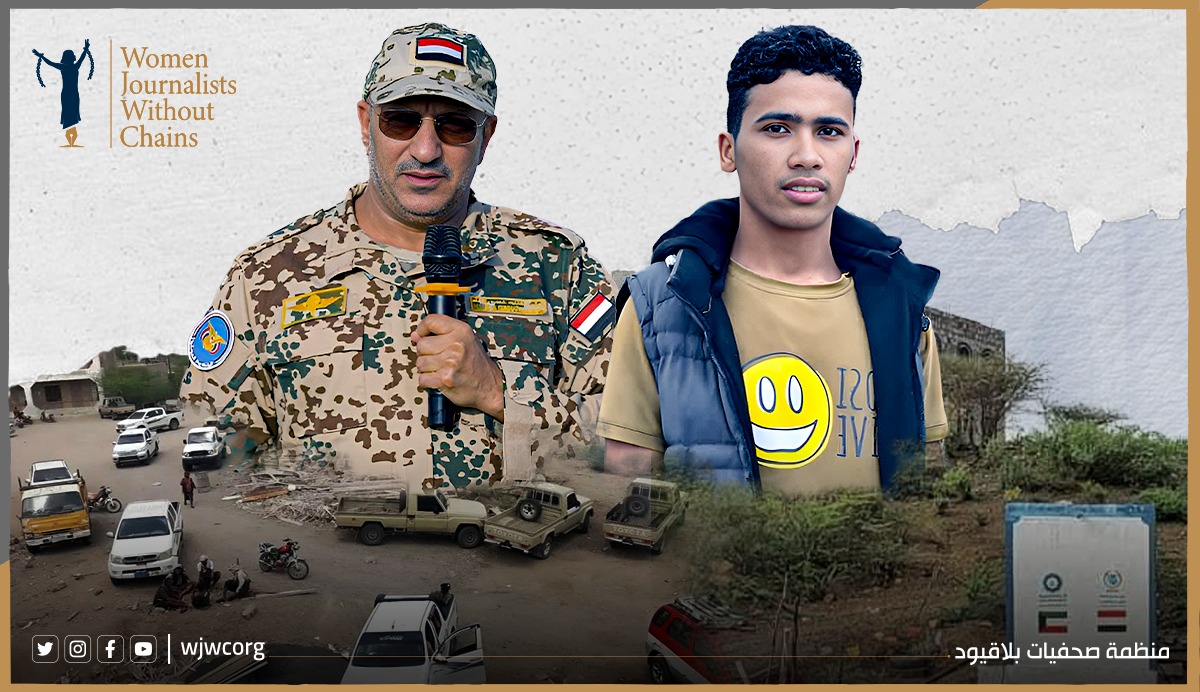
Women Journalists Without Chains has documented a grave escalation of military operations carried out by forces affiliated with Tariq Saleh,
known as the “National Resistance,” in the Al-Wazi’iyah district of Taiz between April 2 and 7, 2026. According to the organization’s findings, these operations were marked by the systematic targeting of residential areas and civilian infrastructure, resulting in serious violations of international humanitarian law.
The documented abuses include extrajudicial killings, arbitrary detentions, forced displacement, and the obstruction of medical care. Women Journalists Without Chains warns that the scale, repetition, and direct impact of these actions on civilians indicate a pattern of collective punishment that may amount to war crimes under international law.
Use of Force in Civilian Areas Lacks Legal Justification
Women Journalists Without Chains explicitly rejected the justification put forward by the forces involved, which framed the operations as efforts to pursue security suspects. The organization stressed that the use of force in densely populated areas violates the fundamental principles of distinction and proportionality, which require parties to a conflict to differentiate between civilians and combatants and to avoid excessive harm to civilian populations.
The organization further noted that these forces operate outside the official military and security institutions of the Yemeni state, raising serious concerns regarding their legal mandate. By conducting law enforcement-style operations without formal authorization and bypassing state institutions, these actions constitute a significant breach of legal accountability frameworks and undermine the rule of law.
Escalation Triggered by Localized Clashes
According to field data and eyewitness testimonies collected by Women Journalists Without Chains, the escalation began on April 2, 2026, following clashes between tribal gunmen and a security checkpoint at the Al-Ahyouq junction in the Al-Shaqira area. Although the initial confrontation resulted in casualties on both sides, it rapidly evolved into a large-scale military campaign.
The operations expanded into several densely populated villages, including Hanna, Al-Rawiya, Al-Hadara, Al-Ghayl, Al-Mazaq, and Misran. Reinforcements, including troops and military equipment, were reportedly deployed from the coastal city of Mocha, intensifying the scale and reach of the offensive.
Civilian Casualties and Targeted Killing of a Young Civilian
Women Journalists Without Chains documented the killing of 19-year-old Burhan Ali Taha on April 6, 2026, in what witnesses described as a direct drone strike while he was standing atop a water well near his family home in Hanna village. The organization reported no evidence of active hostilities in the immediate vicinity at the time of the strike.
Eyewitnesses further indicated that family members attempting to rescue the wounded victim were met with gunfire, preventing them from reaching him for approximately 30 minutes. This delay in providing assistance contributed to his death. Upon eventually transporting him, the family reportedly found the local health facility closed and occupied by military personnel, effectively depriving the victim of urgent medical care.
Additional civilian casualties were reported, including the injury of two women in Al-Rawiya village on April 2, one of whom remains in critical condition. These incidents, Women Journalists Without Chains notes, reflect a consistent failure to adhere to precautionary measures required under international humanitarian law.
Attacks on Healthcare Facilities and Medical Personnel
Women Journalists Without Chains reported that, following the initial clashes, National Resistance forces stormed a healthcare facility in the Hanna area. During the raid, several medical personnel—including Sakhr Farhan al-Mashouli, Alam Farhan al-Mashouli, and Ali Abdulwahid—were detained, while remaining staff were prevented from carrying out their duties.
The organization documented that an injured patient died inside the facility after being left without medical care due to the disruption caused by the raid. In addition, the forces reportedly seized the body of the deceased, an act that constitutes a violation of the dignity of the dead and further compounds the breach of the right to life.
Such actions represent a serious violation of the special protections afforded to medical facilities and personnel under international humanitarian law, which strictly prohibits interference with medical services during armed conflict.
Arbitrary Detentions Targeting Civilians, Including Children
Women Journalists Without Chains also documented a campaign of arbitrary detentions conducted during military raids across multiple villages. Among those detained was 13-year-old Mohammed Rashid al-Talbi, who was reportedly seized at the Al-Ahyouq junction while returning from school.
Additional arrests were recorded in Al-Rawiya, Al-Hadara, Al-Ghayl, and Lower Hanna. While some detainees were later released following local tribal mediation, Women Journalists Without Chains emphasized that such releases do not negate the arbitrary and unlawful nature of the initial detentions.
Movement Restrictions and De Facto Blockade
The organization confirmed that National Resistance forces imposed severe movement restrictions across several villages, including Hanna, Al-Rawiya, Al-Hadara, Al-Ghayl, and Misran. By sealing off village entrances and establishing checkpoints along key routes—particularly those linking the area to Mocha—forces effectively isolated entire communities.
These measures resulted in a de facto blockade, restricting civilians’ access to markets, healthcare, and essential services. Women Journalists Without Chains characterized these restrictions as collective punishment due to their broad and indiscriminate impact on the civilian population.
Militarization of Civilian Infrastructure
Women Journalists Without Chains reported that National Resistance forces converted civilian facilities into military positions, including the “Hanna School for Boys” and “Al-Sakina School,” which were repurposed as barracks. The only health center and pharmacy in Hanna were also seized, while sniper positions and fortifications were established in Al-Hadara market and surrounding civilian areas.
These actions have effectively halted educational activities and severely disrupted access to healthcare. The use of civilian infrastructure for military purposes not only violates international humanitarian law but also exposes civilians—particularly children and patients—to heightened risk.
Forced Displacement and Worsening Humanitarian Conditions
The escalation, characterized by heavy gunfire, the use of medium and heavy weaponry, and widespread troop deployment, has triggered displacement across affected areas. Following the injury of two women in Lower Al-Rawiya, approximately 20 families were reportedly forced to flee their homes due to security threats and fear for their safety.
Women Journalists Without Chains highlighted that the overlap between military operations and residential areas has created an environment of insecurity that undermines civilians’ ability to maintain stable living conditions. The resulting displacement further exacerbates existing humanitarian vulnerabilities.
Legal Assessment: Indicators of War Crimes
Women Journalists Without Chains asserts that the documented violations in Al-Wazi’iyah constitute a pattern of grave breaches of international humanitarian law. These include extrajudicial killings, denial of medical care, attacks on healthcare facilities, arbitrary detention, forced displacement, and the militarization of civilian property.
The organization emphasized that these acts violate Common Article 3 of the 1949 Geneva Conventions, Additional Protocol II of 1977, and established customary international law, particularly the principles of distinction, proportionality, and precaution.
Based on the scale and systematic nature of these violations, Women Journalists Without Chains finds reasonable grounds to believe that they may constitute war crimes under Article 8 of the Rome Statute of the International Criminal Court. The organization further stressed that responsibility extends beyond direct perpetrators to include military and political leadership under the principle of command responsibility.
Call for Independent Investigations and Accountability
Women Journalists Without Chains strongly condemned the documented violations and held the leadership of the National Resistance forces fully responsible. The organization underscored that the internationally recognized Yemeni government bears legal obligations to protect civilians, prevent violations, and ensure accountability in accordance with international law.
Women Journalists Without Chains called for the immediate initiation of independent, impartial, and transparent criminal investigations that meet international standards. It stressed that failure to act would constitute a breach of the state’s legal obligations.
The organization also demanded an immediate halt to all violations, including the militarization of civilian infrastructure, collective restrictions on movement, and arbitrary detentions. It called for the unconditional release of detainees and guarantees for their protection.
Urgent Need for International Oversight
Given concerns regarding the adequacy and independence of domestic accountability mechanisms, Women Journalists Without Chains urged United Nations bodies and relevant international mechanisms to establish an independent international investigation.
Such a process, the organization emphasized, is essential to uncover the truth, ensure impartial accountability, prevent recurrence, and uphold the principle of non-impunity.
Conclusion: Risks to Rule of Law and Civilian Protection
Women Journalists Without Chains concluded that the continuation of such violations without effective accountability poses a serious threat to civilian protection, the rule of law, and the integrity of state institutions. The delegation of military and security functions to armed groups operating outside the legal framework of the state represents a dangerous erosion of the principle of the state’s monopoly on the use of force.
The organization stressed that urgent action is required to halt ongoing violations, restore legal accountability, and safeguard the rights and dignity of civilians in affected areas.